MS Steel Flat Bars Overview
MS Flat Bar Dimensions, Tolerances and Hot Rolling
The MS flat is hot rolled, and the hot-rolled tolerance is wider than most buyers assume. This is not a quality failure. It is inherent to rolling steel at temperature, where the section contracts as it cools and roll wear shifts dimensions across a campaign.
|
Nominal thickness
|
Typical tolerance
|
|
Up to 5 mm
|
±0.3 mm
|
|
5 – 10 mm
|
±0.4 mm
|
|
10 – 20 mm
|
±0.5 mm
|
|
20 – 40 mm
|
±0.7 mm
|
|
Above 40 mm
|
±1.0 mm
|
Width tolerance runs wider still, commonly around ±1 percent, and edges carry a rolled radius rather than a sharp corner.
What this means at the bench: a 50 x 6 mm flat may measure 50.6 x 5.7 mm and still be entirely within specification. If your design requires closer dimensions, either machine the section or order cold-drawn material and pay for it. Complaining about hot-rolled tolerance to a mill is a conversation that goes nowhere.
Mill Scale and Why It Matters More Than People Think
Every hot-rolled flat arrives coated in mill scale, the blue-black iron oxide layer formed as the section cools in air.
It looks protective, and in the short term it slows atmospheric corrosion. But it is brittle, poorly adherent and cathodic to the steel beneath, which produces three practical problems:
- Coatings applied over scale fail. The scale eventually lifts, taking the paint with it. This is the single most common cause of premature coating failure in fabricated MS work
- Welding through scale traps inclusions and generates porosity in the weld
- Where scale is partially removed, the exposed steel corrodes preferentially against the remaining scale, which accelerates rusting rather than slowing it
Removal options, in ascending order of cost and effectiveness: wire brushing, which is adequate for weld preparation only; grinding, suitable for spot removal; pickling, which is chemical and thorough; and shot blasting, which removes scale and simultaneously creates the surface profile a coating needs to key onto.
For anything that will be painted and exposed, shot blasting is not an optional refinement. It is what determines whether the coating lasts three years or fifteen.
MS Flat Bar Sizes, Dimensions and Weight
|
Parameter
|
Range
|
|
Width
|
12 – 300 mm
|
|
Thickness
|
3 – 50 mm
|
|
Length
|
3 m, 6 m, or cut to requirement
|
|
Tolerance
|
To IS 1732
|
|
Edge
|
Rolled, slightly rounded
|
|
Surface
|
Mill scale
|
|
Straightness
|
3 mm per metre maximum
|
Weight per metre is width in mm multiplied by thickness in mm, divided by 1000, multiplied by 7.85.
|
Section
|
Per metre
|
Per 6 m
|
|
25 x 5 mm
|
0.98 kg
|
5.9 kg
|
|
50 x 6 mm
|
2.36 kg
|
14.1 kg
|
|
75 x 10 mm
|
5.89 kg
|
35.3 kg
|
|
100 x 12 mm
|
9.42 kg
|
56.5 kg
|
|
150 x 20 mm
|
23.55 kg
|
141.3 kg
|
Applications of MS Steel Flat Bars
- Gates, grilles and railings. Frames, infill bars, decorative sections, hinges and brackets
- Structural fabrication. Bracing, gussets, stiffeners, cleats, base plates
- Agricultural equipment. Implement frames, tine bars, linkage arms, and harrow components
- Construction. Anchor plates, embedment strips, temporary works, formwork supports
- Material handling. Conveyor frames, guide rails, support brackets, rack members
- General workshop use. Jigs, fixtures, repair fabrication, machine guarding
MS Steel Flat Bars Stockists in India
The service required from MS Steel flat bars stockists in India is simple availability across an unreasonable number of sections. A fabricator working from drawings needs eleven different flats for one job, none of them in quantity, all of them today.
Our stock is arranged around that. Close increments across the commonly used widths and thicknesses, released from single lengths, cut to a customer list, and consolidated into one dispatch.
Material is racked flat rather than stacked loose, because flats leaning against a wall bow under their own weight within weeks, and a bowed flat has to be straightened before it can be used square.
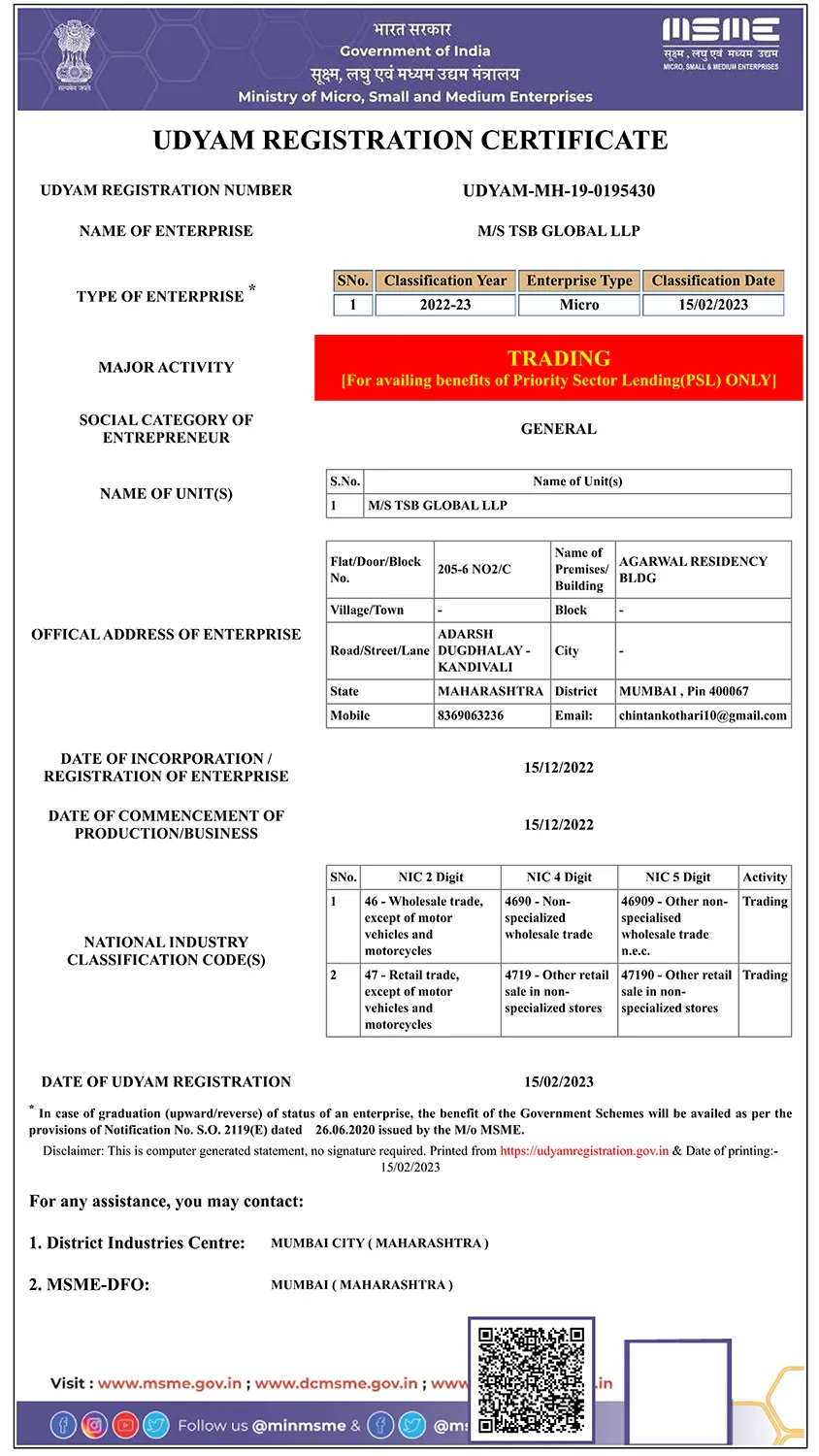
TSB Global LLP is a stockist and supplier, not a rolling mill.
- Close width and thickness increments across sections in regular demand
- Single lengths through to full-tonnage requirements
- Cutting to a customer list, reducing both freight and workshop offcut
- Multiple sections consolidated into a single dispatch and one document set
- Mill test certificates supplied with every consignment
- Flat-racked storage preserving straightness
MS Flat Bar Cutting, Drilling, Bending and Fabrication
MS flat is the most forgiving section in the trade to work with, and the practical notes are mostly about efficiency rather than difficulty.
Cutting. A bandsaw gives the squarest, cleanest cut and the least waste. Abrasive cutting is faster but leaves a heat-affected edge and a burr. Shearing is the fastest of all on thinner sections, but it work hardens the cut edge and can leave a slight distortion at the cut.
Drilling. Straightforward, though mill scale is abrasive and shortens drill life on the first cut. Spot facing through the scale before drilling extends tool life noticeably on repetitive work.
Bending. Low carbon flats bend readily, typically to one to one and a half times the thickness. Bend across the rolling direction where the layout permits, and ensure the edge is free of nicks, since a sheared edge concentrates strain and initiates cracking.
Punching. Practical up to roughly the thickness of the material for round holes. Beyond that, the punch load rises sharply, and drilling becomes the sensible route.
Testing and Certification
The standard release covers chemical analysis, tensile and yield strength, elongation and hardness.
- Bend testing where sections will be formed
- Carbon equivalent reported, supporting welding procedure qualification
- Dimensional verification of width, thickness, camber and straightness
- Third-party inspection through TUV, SGS, BV or a nominated agency
Certification is EN 10204 3.1, with 3.2 arranged where a project requires it. MS flats are frequently sold without documentation, which becomes an obstacle the moment a client or a consulting engineer asks for traceability, so we supply certificates as standard.
MS Steel Flat Bars Exporters in India
As MS Steel flat bars exporters in India, we ship to fabrication contractors, equipment builders and distributors across the Middle East, Africa, Southeast Asia and Europe.
Two things go wrong with flats in transit, and both are mechanical. Wide thin sections strapped at excessive intervals arrive bowed, and bundles stacked without dunnage arrive with edge damage along the contact faces.
Strapping intervals are matched to section width and thickness, with wide, thin sections banded more frequently than heavy ones. Timber dunnage separates bundles and distributes load rather than concentrating it at the corners.
Corrosion protection depends on the destination and the end use. Mill scale gives limited short-term cover, and on extended routes or where material will be stored before use, oiling is applied. Where flats will be shot blasted before fabrication anyway, heavy protection is unnecessary cost.
Hot Dip Galvanising of MS Flat Bars
Most MS flats are galvanised and are especially used in gate, railing, agricultural and outdoor fabrication work, and some features of the process influence how the section is prepared and detailed.
Hot dip galvanising is the process which entails the exposure of the fabricated product to molten zinc at a temperature of about 450 degrees. The zinc is fused with the steel, rather than being applied to the surface, as with paint, and thus is far more resistant to mechanical damage.
What that means in practice:
- Coating thickness depends on steel chemistry. Silicon content in particular affects the reaction, and steel in certain silicon ranges develops a thicker, duller, more brittle coating. This is a chemistry effect, not a galvaniser error, though it is routinely blamed on the galvaniser
- Sharp edges take thin zinc. Coating builds unevenly on a sharp corner, leaving the film thinnest exactly where damage is most likely. Breaking the edges before dipping improves coating life measurably
- Thin sections distort in the bath. The thermal shock releases residual stress, and long, slender flats can come back visibly bowed. Supporting items during dipping and using hot-rolled rather than cold-drawn material both help
- Fabricated assemblies need drainage and venting holes. Trapped air prevents zinc reaching internal surfaces, and trapped zinc adds weight and can burst a closed section
- Welds must be clean. Welding slag does not galvanise, leaving bare patches that rust from day one
Why Choose TSB Global LLP for MS Flat Bars
Choosing the right MS steel flat bar supplier is less about finding a seller and more about getting the right section, quantity and documentation when the fabrication schedule demands it. TSB Global LLP combines broad stock availability with practical supply support across India and export markets. We source hot-rolled flats from established Indian manufacturers and supply sections from 12 mm to 300 mm in width and 3 mm to 50 mm in thickness. Every consignment can be supported with mill test certificates for traceability and project documentation. We also offer cutting to customer lists, multi-section consolidation and export-ready packing. Whether you need a few lengths for workshop fabrication or multiple tonnes for a project, we focus on accurate supply, dependable dispatch and material that arrives ready for use.
Need the right MS flat bar for your next project?
Send us your required width, thickness, length and quantity. Our team will confirm availability, certification and delivery options, then arrange the material to your requirement. Call us now.
About This Page
Tolerance figures given here are indicative of typical hot-rolled practice; the applicable standard governs and should be checked for the specific section. Weight figures are theoretical at nominal density and vary within rolling tolerance. Bend radius guidance is general and should be confirmed by trial before tooling is committed.