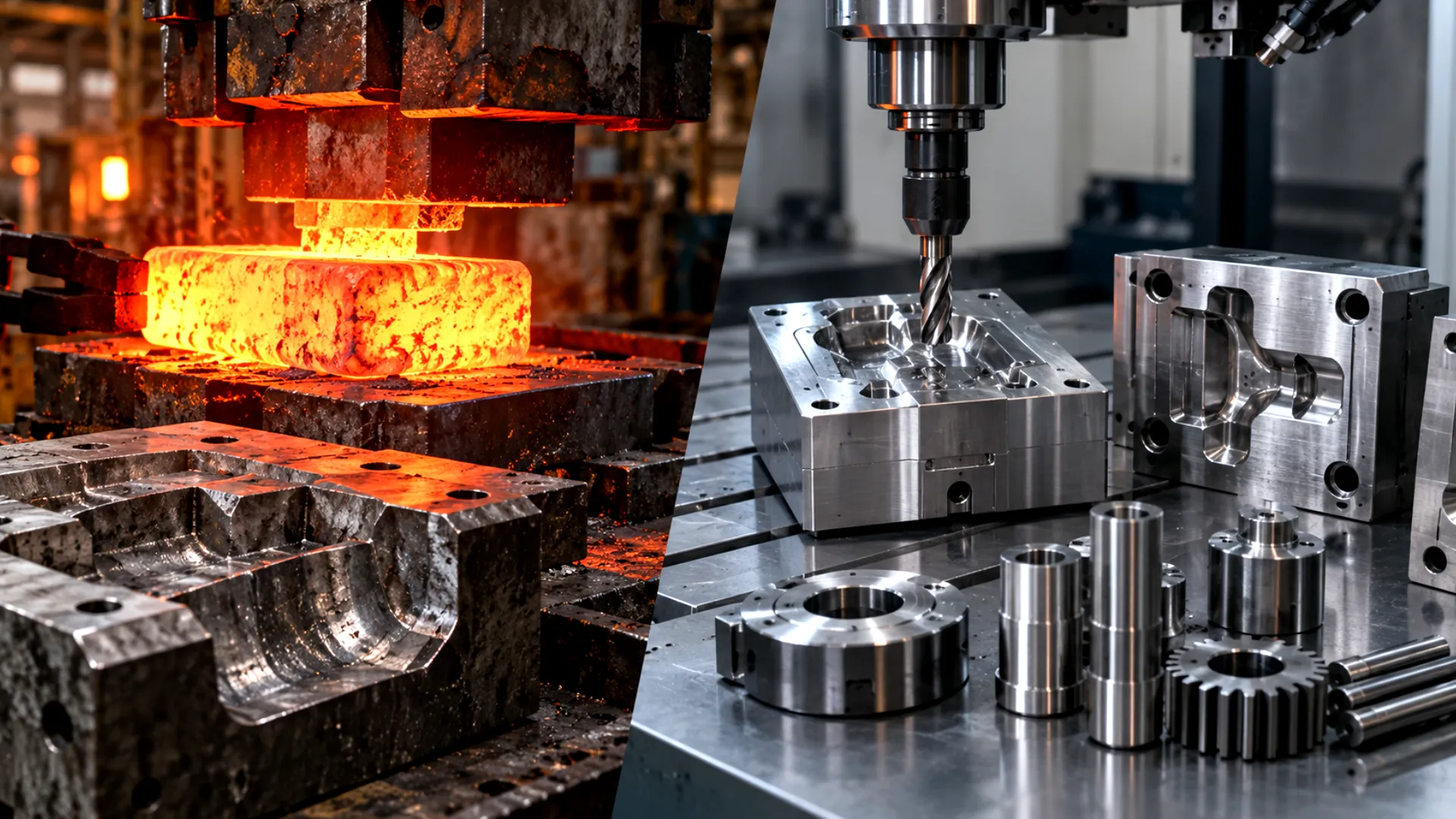
The choice of tool steel is arguably the most important choice made in tool and die production that directly influences tool life, manufacturing efficiency, and the cost per part. In the case of dies, moulds and press tools, the decision between using hot work and cold work tool steel is primarily determined by the operating temperature, mechanical loading and wear. This guide describes the distinction between hot work tool steel and cold work tool steel, describes typical types of hot work steel grades and cold work steel grades, and gives a pragmatic guide to the use of tool steel in industrial tooling uses.
What Is Hot Work Tool Steel?
Hot work tool steel is alloy tool steel that is used in the tooling that repeatedly engages or shapes material at higher temperatures. Hot work steel grades, unlike the traditional cold work grades, are designed to retain beneficial hardness, strength, and toughness at elevated temperatures.
Key Characteristics
- High-temperature strength: Resists mechanical properties in the long term at elevated temperatures
- Toughness: Is not readily cracked by a hit or by thermal shock
- Thermal fatigue resistance: It is able to take repeated stresses, heating and cooling without cracking the surface
- Heat resistance: Low amount of softening under high temperatures
- Resistance to oxidation: Scaling is less in hot workpieces or molten metals
Typical Applications
Applications of hot work die steel include tools that come into contact with hot workpieces or molten material, such as:
- Forging (open and closed die forging)
- Extrusion (aluminium, copper, steel)
- Die casting of dies (aluminium, zinc, magnesium)
- Hot-forming tools and hot shearing blades
- Hot-heading and glass moulds
Common Hot Work Steel Grades
The H-series (AISI) are the primary grades of hot work tool steels:
- H13 (1.2344 / SKD61): The most common hot work tool steel, which provides a good thermal fatigue resistance, toughness and hot hardness balance. Favoured die cast, extrusion and hot forging dies
- H11 (1.2343): Harder than H13, can be used in heavy-impact forging dies and extrusion tooling where the shock resistance is important
- H21: The grade is a tungsten-alloyed grade that has high hot strength and thermal fatigue resistance and is applied in demanding hot forging and extrusion
Choosing the grades of hot work steels is based on the working temperature, impact loading, severity of thermal cycling and the needed die life.
What Is Cold Work Tool Steel?
Cold work tool steel consists of high-carbon and high-alloy steels which are operated at or near ambient temperature, with abrasive wear, chipping and dimensional instability as the most important failure modes, rather than heat softening. These steels are compressive and very hard, such that they can be utilised in cutting, forming and stamping sheet metal, strips and other materials.
Key Properties
- Very hard: 58-65 HRC heat treated.
- Wear resistance: Excellent resistance to abrasive and adhesive wear in cutting and forming.
- Compressive strength: Can support large masses without becoming plastic
- Dimensional stability: The least amount of distortion in the heat treatment, essential in precision tooling
- Edge retention: Retains sharp cutting edges in punching and shearing
Typical Applications
Cold-work steel bars and plates are used in:
- Stamping dies and blanking tools
- Punching equipment and shear blades
- Creating tools and creating dies
- Shears, slitters and trim dies
- Coining, embossing and cold-heading tools
Common Cold Work Steel Grades.
The grades of cold work tool steels are basically of the O, A, and D series:
- O1: Hard oil grade of good toughness and moderate wear resistance; general-purpose punches, dies, and cutting tools in which cost is a consideration
- A2: steel alloy steel that is air-hardened and offers superior dimensional stability and toughness, compared to O1; commonly used in blanking, forming and trimming dies
- D2 (1.2379 / SKD11): This is a high-carbon, high-chromium alloy that has outstanding wear resistance; it is used in stamping of long runs, in stainless steel forming, and in precision blanking tooling
- D3 / D4: Good wear, low toughness; use: extreme abrasive conditions, where impact is not significant
- Powder metallurgy grades (e.g., CPM grades, DC53): Have superior wear resistance-toughness balance in large-volume or high-strength stamping of steel
The grades of cold-work steel are identified based on the hardness, wear resistance, impact loading, material being processed and dimensional accuracy that is needed.
Hot Work vs Cold Work Tool Steel: Key Differences
The basic difference between hot-work metal and cold-work tool steel is their working conditions with the property priorities.
|
Property
|
Hot Work Tool Steel
|
Cold Work Tool Steel
|
|
Operating temperature
|
200–700°C (elevated)
|
Near ambient (≤200°C)
|
|
Hardness (typical)
|
45–55 HRC at working temperature
|
58–65 HRC (room temperature)
|
|
Toughness
|
High (to resist thermal shock and impact)
|
Moderate to high (depends on grade; D2 lower, A2 higher)
|
|
Wear resistance
|
Moderate to good
|
Very high (especially D-series)
|
|
Thermal fatigue resistance
|
Excellent (critical for die casting, forging)
|
Low (not designed for thermal cycling)
|
|
Heat resistance
|
High (retains strength at temperature)
|
Low (softens significantly above ~250°C)
|
|
Typical applications
|
Forging dies, extrusion dies, die-casting dies
|
Stamping dies, punching tools, blanking, shearing, forming
|
|
Common die/tool applications
|
Hot work die steel for forging, extrusion, and die casting
|
Cold-work steel bars for press tools, cutting tools, and forming tools
|
|
Suitable manufacturing processes
|
Hot forging, hot extrusion, die casting, hot forming
|
Cold stamping, blanking, punching, cold forming, cutting
|
Understanding Hot Work Steel Grades
The choice of a grade of hot work steel must be made to suit the process requirements:
- Operating temperatures: H13 is suitable for a maximum temperature of about 600°C, and H21 at higher temperatures
- Impact loading: H11 has increased toughness on heavy impact forging
- Thermal cycling: Die casting and extrusion have a higher thermal fatigue resistance due to the high thermal fatigue resistance of H13
- Conditions of wear: In the case of abrasive hot work, tungsten-alloyed grades (H21) or premium variants should be considered
- Hardness required vs life of dies: Trade-off between crack resistance and wear; H13 is the general purpose trade off
Understanding Cold Work Steel Grades
The options of cold-work steel grades depend on:
- Wear resistance: Long run and abrasive materials in both D2 and powder metallurgy
- Hardness required: All cold work grades will attain 58+ HRC; D-series attain 6062 HRC on a regular basis
- Impact loading: A2 and S-series are tougher than D2 in shock-prone applications
- Processing material: Stainless and high-strength steels require more wear and compressive strength (D2, DC53)
- Cutting/forming conditions: Dimensional stability is needed in fine blanking and precision stamping (A2, D2)
- Dimensional accuracy: Air-hardening (A2, D2) is less distortive than oil-hardening (O1).
Choosing Tool Steel for Dies and Moulds
Depending on the application temperature and loading, manufacturers choose between hot work die steel and cold work tool steel:
- Forging dies: Hot work steel (H11, H13) to thermal fatigue and toughness
- Extrusion dies: H13 aluminium; H21 harsh environment
- Die casting applications: H13 is the standard for aluminium and zinc die casting moulds
- Injection mould parts: This is normally mould steel (P-series or stainless), although hot-runner parts can be made of hot work steel
- Stamping dies: Wear resistance and edge retention: cold work steel (A2, D2)
- Blanking and punching tools: D2 in long runs; A2 in general
- Forming materials: D2, a powder metallurgy grade of high-strength materials
Tool Steel Selection for Press Tools
The various stresses on press tool components (punches, dies, strippers, and guides) vary according to the type of component used; thus, the design of press tools should match the steel used with purpose:
- Punches: Must be hard and durable to wear (D2, M2 in high-speed)
- Die inserts: Must have wear resistance and toughness (D2, A2)
- Strippers and guides: Fairly tough with good toughness (A2, S7)
- Shear blades: Edge stability and high wear resistance (D2, high-chromium)
The knowledge of the types of press tools and operating conditions provides the best selection of press tool steel and long life.
Factors to Consider Before Selecting a Grade
Factors of decision, practical as regards tool and die steel, include:
- Temperature of operation: H-series vs A/D-series are dependent on hot vs cold
- Load, impact: Tougher grades (H11, A2, S7) are preferred
- Wear: Abrasive service requires high-chromium or PM grades (D2, CPM)
- Volume of production: High production volumes warrant high-quality grades of tools with a longer life
- Tool life needed: Compare cost to performance; D2 will wear longer than O1 in important wear applications
- Raw material under processing: Materials with hardness or abrasiveness mean that they demand increased wear resistance
- Heat treatment: Have facilities available to give desired hardness and tempering
- Machinability: O1 is easier than D2; PM grades can be PM-EDM or PM-ground
- Cost: H13 and D2 are cost-effective standards; PM grades are more expensive, although they have a longer life
- Maintenance and replacement frequency: High-quality grades minimise downtime although their initial cost is higher
Conclusion
The use of hot work tool steel and cold work tool steel are two completely different metal types in the industry of tools. For hot-work steel alloys, in the high-temperature applications of forging dies, extrusion dies and die-casting dies, thermal resistance to fatigue and hot toughness are paramount. The cold-work steel grades (such as A2, D2, and powder metallurgy) are used in stamping, blanking, punching, and forming processes, and they are harder, wear-resistant, and dimensionally stable (at ambient temperature).
Correct tool steel selection is based on real working parameters, such as temperature, load, wear, volume of production and the necessary tool life and not on general preferences. The approach of aligning hot work die steel or cold work tool steel with certain press tool parts and processes allows engineers and procurement specialists to ensure optimal tool performance, less downtime, and overall cost of ownership in dies, moulds, and press tools.