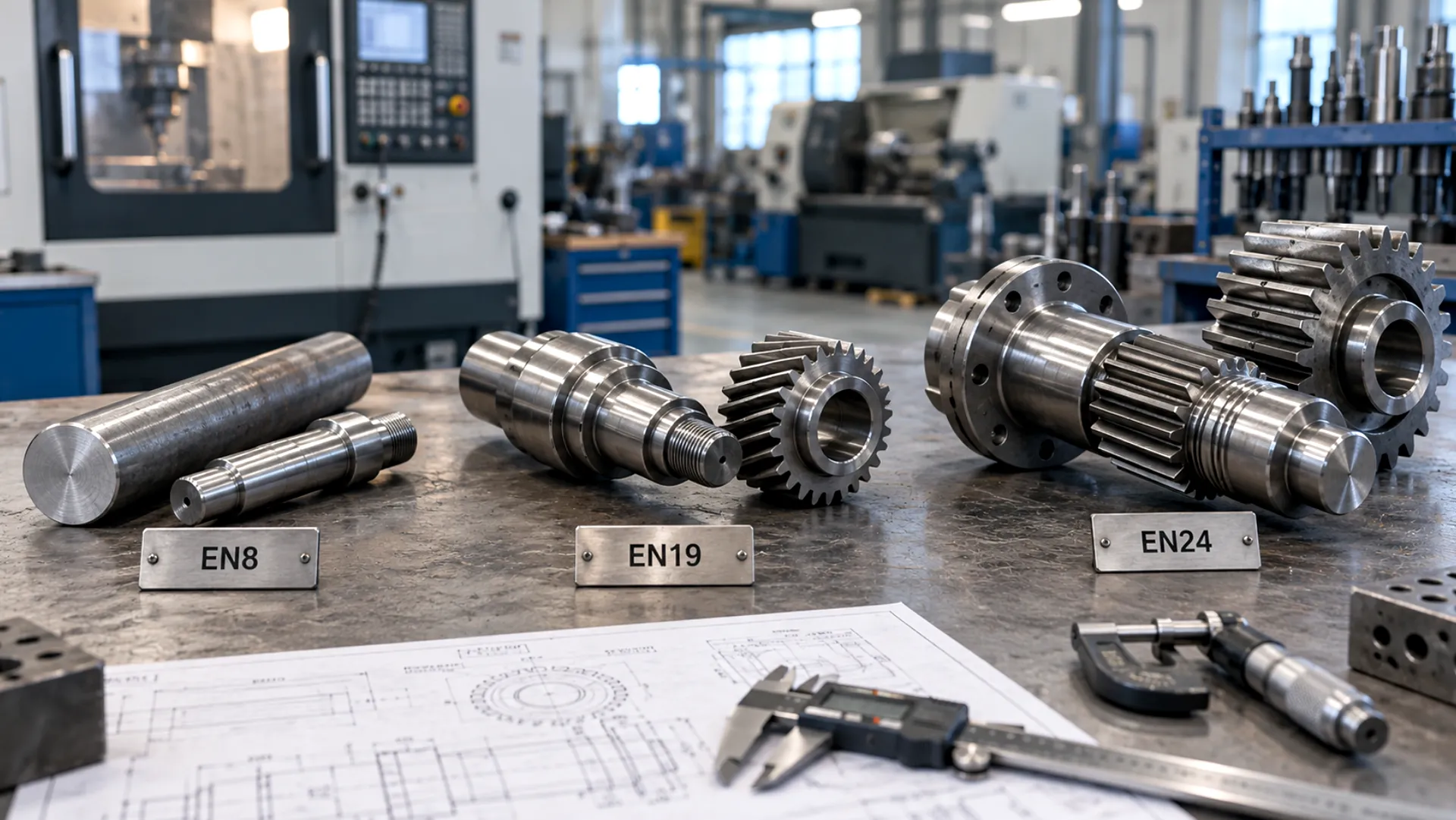
Selecting the right alloy steel grade for a shaft, gear, or precision-machined component isn't just a matter of picking whatever's cheapest or most commonly stocked. For applications beyond what medium carbon steel can handle, alloy steels like EN19 and EN24 offer the added strength, hardenability, and fatigue resistance needed for demanding conditions. Two steels that sit at different points on the strength, hardenability, and cost spectrum. This guide breaks down what separates them and how to choose correctly for your application.
EN19 is a chromium-molybdenum alloy steel, offering strong strength, toughness, and hardenability. It responds well to heat treatment, allowing it to achieve high tensile strength while retaining good ductility — a combination that makes it a preferred choice for components under continuous mechanical stress.
EN19 is typically supplied as:
This grade is widely used for:
EN19's chromium-molybdenum composition gives it a strong balance of strength and toughness, making it a common mid-to-high-performance choice across machined components in engineering and automotive sectors.
EN24 is a nickel-chromium-molybdenum alloy steel, positioned above EN19 in terms of strength, and resistance to fatigue under heavy, repeated stress. The addition of nickel improves toughness at both room and low temperatures, while chromium and molybdenum contribute to hardenability and wear resistance.
Just like EN19, EN24 is supplied across multiple product forms, including:
Typical applications include:
EN24 is generally reserved for applications where component failure carries a high cost — either in terms of safety, downtime, or replacement complexity — because its enhanced mechanical properties justify the higher material cost.
|
Property |
EN19 |
EN24 |
|
Alloy Content |
Chromium-Molybdenum |
Nickel-Chromium-Molybdenum |
|
Tensile Strength |
High |
Very High |
|
Hardenability |
Good |
Excellent |
|
Toughness |
Good |
Superior |
|
Typical Use |
Automotive shafts, gears |
Heavy-duty gears, crankshafts |
|
Cost |
Mid-range |
Highest |
With the differences between the two grades clear, the actual selection comes down to a handful of practical checks against your specific application:
Choosing the wrong steel grade isn't just a technical oversight — it's a business risk that can affect timelines, budgets, and safety.
Even experienced buyers occasionally get the grade selection wrong between these two — usually by defaulting to habit rather than matching the steel to the actual application.
Avoiding these mistakes comes down to one principle: match the grade to the application's real mechanical demands — load, impact, temperature, and hardenability requirements — rather than defaulting to whichever grade is more familiar or cheaper.
Choosing between EN19 and EN24 ultimately comes down to matching the steel's mechanical properties to the real-world demands of your shaft, gear, or machined component. EN19 offers a strong middle ground for moderate-to-high stress components, while EN24 is the go-to choice when maximum strength, toughness, and fatigue resistance are non-negotiable. Understanding these distinctions upfront helps avoid costly material mismatches down the line — whether you're sourcing Alloy Steel Round Bars, Flat Bars, or Forged Shafts for your next project.
Get in touch with our team to discuss your load, environment, and manufacturing requirements — we'll help you match the right steel grade to the job.
We come back with the source named and the lead time split between stock and mill-rolled material — so your planning is based on a real date, not an optimistic one.